What is the simplest way to make a union or an intersection of Sets in Java? I've seen some strange solutions to this simple problem (e.g. manually iterating the two sets).
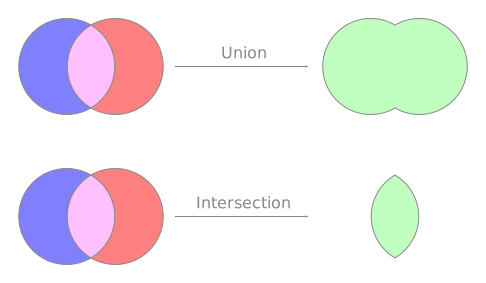
What is the simplest way to make a union or an intersection of Sets in Java? I've seen some strange solutions to this simple problem (e.g. manually iterating the two sets).
 On
On
You can achieve this using Google's Guava library. The following explanation is given below with the help of an example:
    // Set a
    Set<String> a = new HashSet<String>();
    a.add("x");
    a.add("y");
    a.add("z");

    // Set b
    Set<String> b = new HashSet<String>();
    b.add("x");
    b.add("p");
    b.add("q");
Now, Calculating Intersection of two Set in Java:
Set<String> intersection = Sets.intersection(a, b);
System.out.printf("Intersection of two Set %s and %s in Java is %s %n",
                a.toString(), b.toString(), intersection.toString());
Output: Intersection of two Set [z, y, x] and [q, p, x] in Java is [x]
Similarly, Calculating Union of two Set in Java:
Set<String> union = Sets.union(a, b);
System.out.printf("Union of two Set %s and %s in Java is %s %n",
                a.toString(), b.toString(), union.toString());
Output: Union of two Set [z, y, x] and [q, p, x] in Java is [q, p, x, z, y]
You can read more about guava library at https://google.github.io/guava/releases/18.0/api/docs/
In order to add guava library to your project, You can see https://stackoverflow.com/a/4648947/8258942
On
While guava for sure is neater and pretty much standard, here's a non destructive way to do union and intersect using only standard Java
Set s1 = Set.of(1,2,3);
Set s2 = Set.of(3,4,5);

Set union = Stream.concat(s1.stream(),s2.stream()).collect(Collectors.toSet());
Set intersect = s1.stream().filter(s2::contains).collect(Collectors.toSet());
    import java.util.*;

public class sets {
    public static void swap(int array[], int a, int b) { // Swap function for sorting
        int temp = array[a];
        array[a] = array[b];
        array[b] = temp;
    }

    public static int[] sort(int array[]) { // sort function for binary search (Selection sort)
        int minIndex;
        int j;
        for (int i = 0; i < array.length; i++) {
            minIndex = i;
            for (j = i + 1; j < array.length; j++) {
                if (array[minIndex] > array[j])
                    minIndex = j;
            }
            swap(array, minIndex, i);
        }
        return array;
    }

    public static boolean search(int array[], int search) { // Binary search for intersection and difference
        int l = array.length;
        int mid = 0;
        int lowerLimit = 0, upperLimit = l - 1;
        while (lowerLimit <= upperLimit) {
            mid = (lowerLimit + upperLimit) / 2;
            if (array[mid] == search) {
                return true;
            } else if (array[mid] > search)
                upperLimit = mid - 1;
            else if (array[mid] < search)
                lowerLimit = mid + 1;
        }
        return false;
    }

    public static int[] append(int array[], int add) { // To add elements
        int newArray[] = new int[array.length + 1];
        for (int i = 0; i < array.length; i++) {
            newArray[i] = array[i];
        }
        newArray[array.length] = add;
        newArray = sort(newArray);
        return newArray;
    }

    public static int[] remove(int array[], int index) { // To remove duplicates
        int anotherArray[] = new int[array.length - 1];
        int k = 0;
        if (array == null || index < 0 || index > array.length) {
            return array;
        }
        for (int i = 0; i < array.length; i++) {
            if (index == i) {
                continue;
            }
            anotherArray[k++] = array[i];
        }
        return anotherArray;
    }

    public static void Union(int A[], int B[]) { // Union of a set
        int union[] = new int[A.length + B.length];
        for (int i = 0; i < A.length; i++) {
            union[i] = A[i];
        }
        for (int j = A.length, i = 0; i < B.length || j < union.length; i++, j++) {
            union[j] = B[i];
        }
        for (int i = 0; i < union.length; i++) {
            for (int j = 0; j < union.length; j++) {
                if (union[i] == union[j] && j != i) {
                    union = remove(union, j); // Removing duplicates
                }
            }
        }
        union = sort(union);
        System.out.print("A U B = {"); // Printing
        for (int i = 0; i < union.length; i++) {
            if (i != union.length - 1)
                System.out.print(union[i] + ", ");
            else
                System.out.print(union[i] + "}");
        }
    }

    public static void Intersection(int A[], int B[]) {
        int greater = (A.length > B.length) ? (A.length) : (B.length);
        int intersect[] = new int[1];
        int G[] = (A.length > B.length) ? A : B;
        int L[] = (A.length < B.length) ? A : B;
        for (int i = 0; i < greater; i++) {
            if (search(L, G[i]) == true) { // Common elements
                intersect = append(intersect, G[i]);
            }
        }
        for (int i = 0; i < intersect.length; i++) {
            for (int j = 0; j < intersect.length; j++) {
                if (intersect[i] == intersect[j] && j != i) {
                    intersect = remove(intersect, j); // Removing duplicates
                }
            }
        }
        System.out.print("A ∩ B = {"); // Printing
        for (int i = 1; i < intersect.length; i++) {
            if (i != intersect.length - 1)
                System.out.print(intersect[i] + ", ");
            else
                System.out.print(intersect[i] + "}");
        }
    }

    public static void difference(int A[], int B[]) {
        int diff[] = new int[1];
        int G[] = (A.length > B.length) ? A : B;
        int L[] = (A.length < B.length) ? A : B;
        int greater = G.length;
        for (int i = 0; i < greater; i++) {
            if (search(L, G[i]) == false) {
                diff = append(diff, G[i]); // Elements not in common
            }
        }
        for (int i = 0; i < diff.length; i++) {
            for (int j = 0; j < diff.length; j++) {
                if (diff[i] == diff[j] && j != i) {
                    diff = remove(diff, j); // Removing duplicates
                }
            }
        }
        System.out.println("Where A is the larger set, and B is the smaller set.");
        System.out.print("A - B = {"); // Printing
        for (int i = 1; i < diff.length; i++) {
            if (i != diff.length - 1)
                System.out.print(diff[i] + ", ");
            else
                System.out.print(diff[i] + "}");
        }
    }

    public static void main(String[] args) {
        Scanner sc = new Scanner(System.in);
        System.out.println("Enter the operation");
        String operation = sc.next().toLowerCase();
        System.out.println("Enter the length of the first set.");
        int l1 = sc.nextInt();
        System.out.println("Enter the length of the second set.");
        int l2 = sc.nextInt();
        int A[] = new int[l1];
        int B[] = new int[l2];
        System.out.println("Enter the elements of the first set.");
        System.out.print("A = ");
        for (int i = 0; i < l1; i++) {
            A[i] = sc.nextInt();
        }
        System.out.println("Enter the elements of the second set.");
        System.out.print("B = ");
        for (int i = 0; i < l2; i++) {
            B[i] = sc.nextInt();
        }
        A = sort(A); // Sorting the sets before passing
        B = sort(B);
        sc.close();
        switch (operation) {
            case "union":
                Union(A, B);
                break;
            case "intersection":
                Intersection(A, B);
                break;
            case "difference":
                difference(B, A);
                break;
            default:
                System.out.println("Invalid Operation");
        }
    }
}
When I think of union and intersection, it is in the first loop an operation on sets, i.e. a map
Set<T> x Set<T> → Set<T>
Not clear, why it would appear in Java design that shirtsleeved.
static <T> Set<T> union(Set<T> a, Set<T> b)
{
    Set<T> res = new HashSet<T>(a);
    res.addAll(b);
    return res;
}

static <T> Set<T> intersection(Set<T> a, Set<T> b)
{
    Set<T> res = new HashSet<T>(a);
    res.retainAll(b);
    return res;
}
The simplest one-line solution is this:
The above solution is destructive, meaning that contents of the original set1 my change.
If you don't want to touch your existing sets, create a new set: